• Skip to primary navigation
  • Skip to main content

SailFun

providing information for sailors

  • Home
  • Sailing Clubs
  • Sailing Businesses
  • About
  • Contact us
  • Blog
    • Article and Press Releases
  • News
  • Advertise here

Great prices and deals on SMS and get 10 free text messages

January 21, 2012 by superuser Leave a Comment

Ok, so this isn’t about learning to sail, or sailing holidays, its just we want to share a great service provider with you.

www.txtlocal.com is a great low cost, discount provider of SMS text messages, in bulk. To start off with they give you 10 free text messages. Then you buy credits, starting at 100 credits, current prices start at 4.9p per text, that is pretty cheap.

As one of the UK leading bulk SMS providers Txtlocal (www.txtlocal.com) they provide online SMS text message services to help every on from small clubs to mega corporations to communicate by SMS text messages. In fact Txtlocal have over 15,000 customers, and really easy to use website.

We find them simply the best text SMS service for our small business.

It is away worth searching the web for discount vouchers or promotion codes, free offer (they already give you 10 free SMS text messages) or other forms of discounts, but often they have discounts and deals available on their web site, so why not visit them right now and see what is available, by following the advert just below.


Filed Under: Blog, Other useful stuff Tagged With: deals, SMS, text

9 Different types of sailing holidays explained

January 19, 2012 by superuser Leave a Comment

The following type of sailing holiday are explained, there are of course many variations, and different types are more predominant in different parts of the world. Feel free to lets us know in the comments, of any alternative formats you have come across, and also share your top tips from your experiences.

Flotilla

Flotilla sailing allows those with little experience the opportunity to manage their own yacht by day, but in the comfort of knowing there is an organised group and support nearby if things get a bit tricky. The Flotilla will normally follow a pre-planned itinerary of overnight anchorages, in sheltered harbours with of course a suitable local restaurant. The pace isn’t hard, and it tends to be quite a chill-out holiday.  A top tip, is if you have active teenagers who get bored easily, it to take the option of a windsurfer on-board, so they can blast out their energy when you reach your stops, allowing you to relax with your favourite glass of vino.

Cultural / Cusine Based Sailing Holidays

As the name might suggest, a cultural sailing holiday, is based around visits to historic locations and monuments. Sailing from location to location as a method of getting between islands or special places. Also as the name suggests, a cuisine based sailing holiday normal involves visiting different locations to taste different styles of food.

Bareboat Charter

Commonly called a bareboat, a bareboat charter is the hire of yacht without a crew. Although the name might indicate that the boat is bare of all equipment, that shouldn’t be the case (but check first!). Bareboat charters are for the experienced, and hopefully qualified yachts person, who know how to handle a boat in the specific waters and also is capable of voyage planning. Any charter company would expect at least an International Certificate of Competence (ICC), which you can obtain if you hold an RYA Day Skipper certificate. However the level of competence to safely charter is more in line with the RYA CoastalSkipper certificate. Depending on the ‘flag’ of the vessel, you may need other certifications, for instance the ‘Short Range Certificate’ is the minimum qualification required by law to control the operation of VHF and VHF Digital Selective Calling (DSC) equipment on any British flagged vessel.

Many sailing holiday companies offer bareboat charters, and reputable companies should be able to brief you fully on laws regulations appropriate to your planned sailing area.

Crewed / Skippered Charter

So, if you are not so experienced or qualified to feel comfortable with a bareboat charter, you can charter yachts with a skipper & or a crew. They of course will be fully qualified (might be worth checking that!)

Cabin Charter

Chartering a whole yacht can be a bit expensive unless it is shred between several / many people. Certainly chartering a yacht with a skipper & crew would be out of reach of many single people, unless they have won the lottery. The solution is ‘cabin charter’, where you take one or more berths on a multi-berth yacht. Even the smallest yachts will sleep 5 and they don’t have to be massive to sleep 10, although arrangements can be quite ‘close’. Cabin Charter doesn’t necessarily mean you get a private cabin.

Sailing Shool Course

To some the ideas of a training course and holiday don’t go together. But for others spending a week sailing around the Solent whilst obtaining your RYA Day Skipper or Coastal Skipper qualification is an ideal antidote to everyday life. Of course its not just Yacht Sailing that can be learnt this way, there are many dinghy sailing schools in beautiful locations around the world that run week long courses, some designed for kids, some for the whole family. All these sailing course can be great ways of making new friends, as you are thrown into a new situation with a group of complete strangers, the physical and mental challenges of sailing soon create lasting bonds.

Shore based Dinghy & Windsurf Holiday club

These are very popular with enthusiastic amateur sailors and other that appreciate something to do, rather than sunbathing, on holiday. Shorebased holiday clubs have all the equipment ready for you to use, and people on hand to help you get on to the water. Many also run training courses within the club, normally you sign up for the courses at the time of booking. Being shore based, in a holiday location, means that any non-sailing family members can go and do tourist things, or sunbath, or drink at the bar watching you struggle at sea, whatever they fancy.

Family Dingy Regatta Week

A dinghy regatta week is suited to enthusiastic families of dinghy sailors, whether the kids sail and mum and dad don’t is really optional. Normally you will already be dinghy sailors with your own boats, waterproofs etc and you pack off a few hundred miles from your own club to enjoy another part of the country.

Henri Lloyd Falmouth Week starts with the Falmouth Classics event, providing a special atmosphere and superb spectacle to kick off the week. Then follows six days of competitive racing for keelboats, traditional craft and dinghies in the waters of Falmouth Bay, the Carrick Roads and the Harbour, with a Champagne Day on Wednesday. Activity on the water is matched by a lively Shoreside programme of daytime and evening entertainment, culminating in a magnificent firework display over the Harbour. With a Grand Prize Giving party in the Royal Cornwall Yacht Club at the end of the Week.

Regatta weeks are normally racing based, although they are often some ‘fun’ variations on racing for the less serious racer. Social events such as BBQs, beer tents and evening discos are the norm. Some, like the one mentioned, combine both yacht and dinghy events.

Yacht Regatta Events

Probably for the hard core yacht racers, to group together and charter (or crew a friend or associates or company yacht). The range is massive from the 1 day Round the Island Race around the UK’s Isle of Wight

The race regularly attracts over 1,700 boats and around 16,000 sailors, making it one of the largest yacht races in the world and the fourth largest participation sporting event in the UK after the London Marathon and the Great North and South Runs

through to the niche regattas like Antigua Classic Yacht Regatta, with a only a few, but stunningly beautiful yachts.

Filed Under: Blog, Sailing Holidays

Single Berth Sailing Holidays

January 15, 2012 by superuser Leave a Comment

At the London Boat show, the Cowes based One Stop Sailing launched their exiting single berth Holidays in Croatia.

They have achieved this by partnering with Sailing Europe. These single berth holidays don’t need to be restricted to sailing, but include other adventures such as snorkeling, cycle rides, climbing and much more. However, if you are not looking for a full out adventure holiday, just peaceful sailing their are options for you too, including one where you can explore the Croatian cuisine, or just explore traditional Croatia.

Prices for a weeks holiday start at around 400 Euros each.

You can get more information from www.onestopsailing.com

Filed Under: Blog, Sailing Holidays Tagged With: sailing holiday, single berth

London Boat Show 2012

January 6, 2012 by superuser Leave a Comment

The London Boat Show is a traditional January venture for sailors who are missing sailing in the deep mid winter blues.

This year the Tullet Prebon London Boat Show was opened by Tamara Ecclestone. She was wearing a pink two piece, but what was different to expectations was she opened the show barefoot.

Formula 1 mogul Bernie Ecclestone’s daughter brought some glamour to the proceedings but was forced to abandon her trade mark £2,000 Louboutin’s shoes so she did not damage the decks of the multi-million pound deck she was standing on.

The London Boat Show is a great place to go to find a suitable sailing holiday for the summer, amongst the many exhibitors you can find:

  • Neilson
  • Sail Ionian
  • Sailing Holidays Ltd
  • Seafarer Cruising & Sailing Holidays
  • The Moorings Sailing Holidays Ltd
  • Nautilus Yachting

And a whole host of sailing schools.

Why not visit the London Boat Show in real life? For more information on the show and exhibitors see http://www.londonboatshow.com


[google-maps width=465 height=200]

Filed Under: Blog, Sailing Holidays Tagged With: London Boat Show, Sailing Holidays

Learning the ropes

January 2, 2012 by superuser Leave a Comment

Tying knots is an essential part of sailing. Most boats have plenty of rope, as rope is the most effective form of running rigging.   Today I won’t go into the details of knot tying, but rather I will refer you to simply the best website there is on knot tying.

There is no need to buy a book any more with resources like this, in fact I always found learning from static pictures rather difficult. Animated knots gives you clear visual guides to tying knots.

If you are a dinghy sailor, you can actually get away with just two knots. The figure of eight and the bowline. If you are sailing a bigger boat there are probably 3 or so more knots that come in handy.

Nothing beats practice, and the ability to tie a bowline on a bouncy boat, in the dark, is a definite bonus skill. So get that bit or rope and keep on practicing.

The site to visit is

Animated Boating Knots by Grog
Enjoy it, it is good.

Filed Under: Blog, Learning to Sail Tagged With: knots, learning to sail, ropes

Goal Setting – The Professional Approach

June 1, 2011 by superuser Leave a Comment

Goal Setting – The Professional Approach

Have you set any goals for the coming season? If you have, then well done – you are on the right track. Of all the things that full-time, professional sailors do that the rest of us weekend warriors do not do, structured goal setting is probably the most important. Fortunately it is also one of the less demanding activities (compared to, say, completing 10,000 perfect tacks). With the right approach it can be done quickly – and it can even be fun.

Why goal setting makes a difference

It’s not just about the time and money (and energy!) you have available, it’s how you spend those resources. For example, practising some boathandling exercises might be a better use of a day’s sailing than doing a couple of club races. Or maybe a day’s coaching is a better investment than buying a new jib.

Think about what you want to achieve, then set some specific goals. Goal setting has been shown to be a major factor in improving performance in almost every area of life; yet most of us still do not set any goals, let alone reach them. Maybe we are protecting ourselves: if we do not set goals we cannot fail at them! But that is lazy thinking and it brings only frustration.

So let’s look at setting some sailing goals – and planning how to achieve them.

Mapping out your road to success

Think about your long-term sailing goals. How exactly do you want to improve? What specific goal will motivate you to do everything you need to do to achieve it? Maybe you want to be so fit and skilled that you are ‘at one with your boat’ in all conditions; or maybe you just want to be able to compete in 25 knots without capsizing.

Try to stick to Performance and Process goals: those that depend entirely on your own efforts and abilities. You can set Outcome goals: winning a club series or a championship – or even an Olympic medal. But you have to accept that achieving such goals is not completely within your control.

You want to improve as much as possible with the talent, time and money you bring to the game, so aim high. Describe your goal in inspirational terms and write it down somewhere as your Main Goal. Once you know where you are going, you can start to work out how to get there. What’s most important in the goal-setting process is the journey you take to reach the desired outcome.

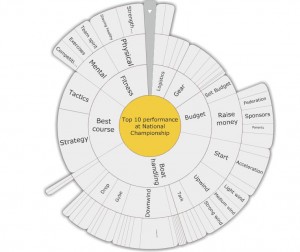
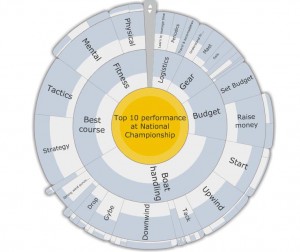
You can do quite a lot on paper – as long as you keep it somewhere safe and easily accessible. With decent software though, not only can you define goals and plans, you can also track your progress dynamically and adapt quickly. I like Goalscape (www.goalscape.com) because it can capture an entire campaign in a single picture (as shown in the screenshots that accompany this article) – and because it’s really easy to use.

Lots of sailors in Olympic classes use this tool, but in fact it can help anyone who is serious about improving their skills – and results.

Next year’s results depend on what you do right now

The best way to plan your route to your main goal is to break down your sailing into different areas and work out exactly what you need to do in each.

The fundamental ‘building blocks’ are always the same, whatever your current abilities and whatever your goals. In the diagram below these are the top-level subgoals around the main goal in the centre. (The size of each subgoal’s slice represents its relative importance.)

Three of these goals are about arriving at the starting line in the best possible shape:
• Logistics (planning the year: training, events, travel and accommodation, etc)
• Gear (hull, rig, sails, foils, fittings, clothing, etc)
• Budget (money available for equipment, events etc)

These goals are all about preparation. You can start thinking right now about what you need to do and how to do it.

The other three are about the abilities you need when racing:
• Boat handling (executing every skill in all conditions)
• Finding the best course (strategy and tactics)
• Fitness (mental skills, physical strength, balance, etc)

These are the core goals for maximising your performance on the water.

Define specific goals in each area and plan exactly how you are going to achieve them. Break down each subgoal area into further subgoals:

Keep breaking down the subgoals even further until you have defined specific actions to achieve them all. Below is a detail view of the ‘Boat handling’ area, showing the key aspects of boathandling that you need to master in order to race properly and the specific manoeuvres involved. (Can you guess what the ‘hidden’ one at 11 o’clock is?)

The full structure shown below is suitable for Olympic athletes and club sailors alike ( from time to time GoalScape make available these goal maps for sailors and other activities when you purchase their software, contact them for details of what currently they will offer for free).

You can adapt this framework to reflect your personal goals and circumstances – and to suit class-specific requirements. You might want to change the importance you assign to each goal, delete some lower level goals or even add some new ones of your own.

Focus your efforts

When you first do a proper goal setting exercise, it can be exciting when you see all the different areas where you can improve. It can also be overwhelming! A common mistake here is to go from doing nothing to trying to do too much all at once.

A good way to start is to identify a maximum of three areas that offer the greatest opportunity for improving your performance. How do you do that? One way is to think back through your last season, or even your last race. Be honest: what did you do well and what let you down? Where could you make the greatest improvements in the shortest time? If you capsized a lot when tacking in strong winds for example, you have an easy answer.

So if you can come up with three ideas for tacking more safely, then you can write them into your tacking process breakdown as subgoals:

1. Ease sails sooner before the tack
2. Steer more slowly through the tack
3. Move more quickly up to the new windward side

Work out some good ways to practise and how to measure your progress. If you train in a pair or a group, watch what the others do. Ask them to watch you and give you some specific feedback.

On the other hand if your boat handling is good but your race strategy is poor, look at your information-gathering and decision-making processes.

Find out how other people do all this: talk to some of the good guys – or visit a sailing forum. On Andy Rice’s www.SailJuice.com, anyone can ask a question: an expert contributor or another member will answer it; or Andy will ask some top sailors for their views.

Debrief thoroughly after each practice or competition. Be positive: agree where you have improved and how much. Update your written plan – seeing your progress advancing increases your motivation – and highlights what you need to prioritise next.

The chart below shows a team’s progress (darker shading) with a month to go before their nationals.

These guys need to keep practising their boat handling, especially in strong winds. They also need to do some serious work on their starting process and slow sailing skills. Better starts will help their first beats as well!

If you identify specific problems in every area and find three possible solutions for each of them (or just one!), you are already doing better than 95% of your opposition.

Stick at it!

Persist with this process of gradual, incremental improvements in the key areas of your game and your weaknesses will start to disappear. You may find that your old failings become your new strengths: each is a separate proof of the effectiveness of your process.

Soon you will enjoy doing the very things that you used to hate or fear. If you were nervous in strong winds you will be more competent and more confident: you will love racing in a breeze when you can stay upright while your rivals are falling over.

Double Olympic Champion Iain Percy once said: “I enjoy the process of improvement almost more than the winning itself. That’s where the real satisfaction comes. Identify your weaknesses, set goals, practise until you get better – and the results will look after themselves.”

So start setting some goals for your sailing right now. It is the single activity most likely to improve your performance and results, so there is simply no excuse not to do it. And don’t stop, even if you reach your goals – in fact especially if you reach your goals. Instead, set yourself new goals in every area – and start working on them immediately.

Richard Parslow & Andy Rice
© www.Goalscape.com & www.SailJuice.com

reproduced on www.sailfun.co.uk by kind permission of the authors

Filed Under: Blog, Learning to Sail Tagged With: goal setting, goal setting software, mind apping software, planning to win, training

  • « Go to Previous Page
  • Page 1
  • Interim pages omitted …
  • Page 14
  • Page 15
  • Page 16
  • Page 17
  • Go to Next Page »

Copyright © 2026 · Genesis Sample on Genesis Framework · WordPress · Log in